Are ballrooms making a comeback? Is beige the new white? Did florals quietly become optional?
No. No. And not exactly. But if you’ve heard whispers like that floating around heading into 2027, here’s what’s actually happening instead.
What should wedding planners expect from weddings in 2027? Based on what we watched shift through 2026, the short answer is this: couples are moving away from décor-first weddings and toward intention-first ones, where personalization, the venue itself, and experience over decoration drive every decision. Three trends stand out, and each one changes what you should actually be vetting when you’re comparing venues for a client, not just what you’re pitching them on inspiration boards.
The first half of 2026 made one thing clear. Events are becoming more intentional. We’re seeing a real shift away from designing a wedding around décor alone and toward building something deeply personal, experiential, and emotionally memorable, and we expect that shift to accelerate heading into 2027.
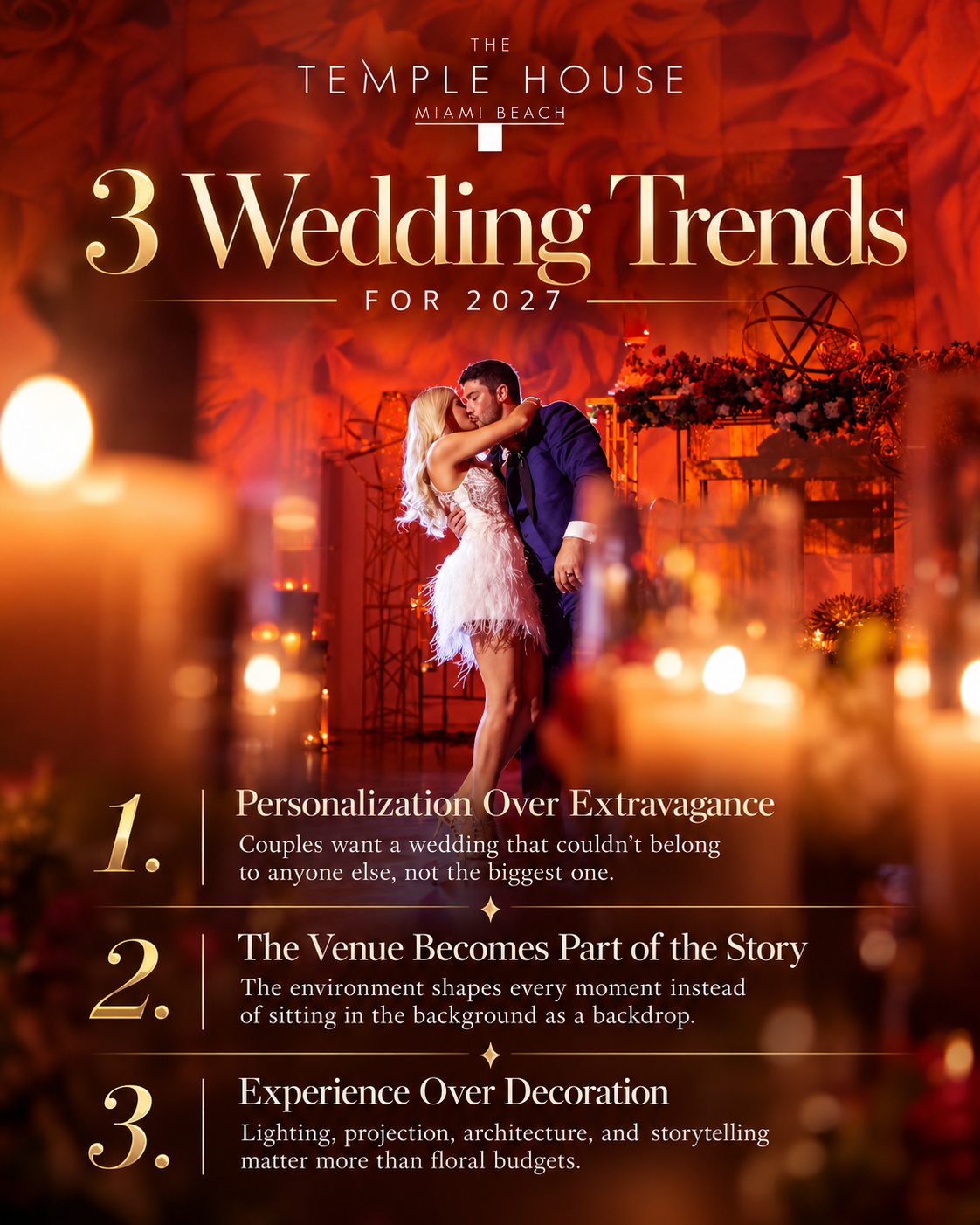
Trend 1: Personalization Over Extravagance
Couples don’t want the biggest wedding anymore. They want one that couldn’t belong to anyone else.
That’s a real shift from a few years ago, when scale and spend were the measure of a memorable wedding. In 2027, we expect personalization to matter more than guest count or price tag, and planners who lean into that will have an easier time selling the vision to clients who are tired of looking at the same Pinterest boards their friends used.
What to vet for: Before you put a venue on a client’s shortlist, ask how much of the event the venue can actually customize. Can the layout change entirely between events, or does every wedding end up looking like a version of the one before it? Can the venue build visuals, lighting, and scenes specific to this couple’s story, or are you working within a fixed look with a few decor add-ons layered on top? A venue that can only decorate around a couple’s story isn’t personalizing it. A venue that can rebuild the room around it is.
Trend 2: The Venue Becomes Part of the Story
The environment isn’t a backdrop anymore. It shapes how every moment of the night is experienced.
We expect this to be the biggest differentiator among Miami venues in 2027. A ballroom with good lighting is still a ballroom. A space built to transform is something else entirely, and couples are starting to notice the difference before they even book a tour.
What to vet for: This is where a lot of venues oversell themselves. Ask directly whether the space is a true blank canvas, meaning no fixed layout, no built in decor that has to be worked around, and enough flexibility to become a completely different environment from one event to the next. Ask to see photos from at least two or three past events at the same venue. If every single one looks like the same room with different flowers, it’s not actually a blank canvas, whatever the sales deck says.
Trend 3: Experience Over Decoration
Thoughtful lighting, projection, architecture, and storytelling are starting to matter more than floral budgets.
We think this is the trend planners can get ahead of fastest, because it’s the easiest to misjudge on a venue tour. A room can look stunning in photos and still fall flat on the night itself if the only thing holding the design together is rented decor stacked around the edges.
What to vet for: Ask what’s actually built into the venue versus what gets rented and trucked in for one night. A permanent projection system behaves very differently than a projector rented for a single event, both in what it can do and in how much can go wrong. Ask who designs the visual content, whether it’s created specifically for each wedding or pulled from a shared library, and whether the production team is in house or coordinated separately from the venue itself. Those answers tell you how much of the “experience” is actually real.
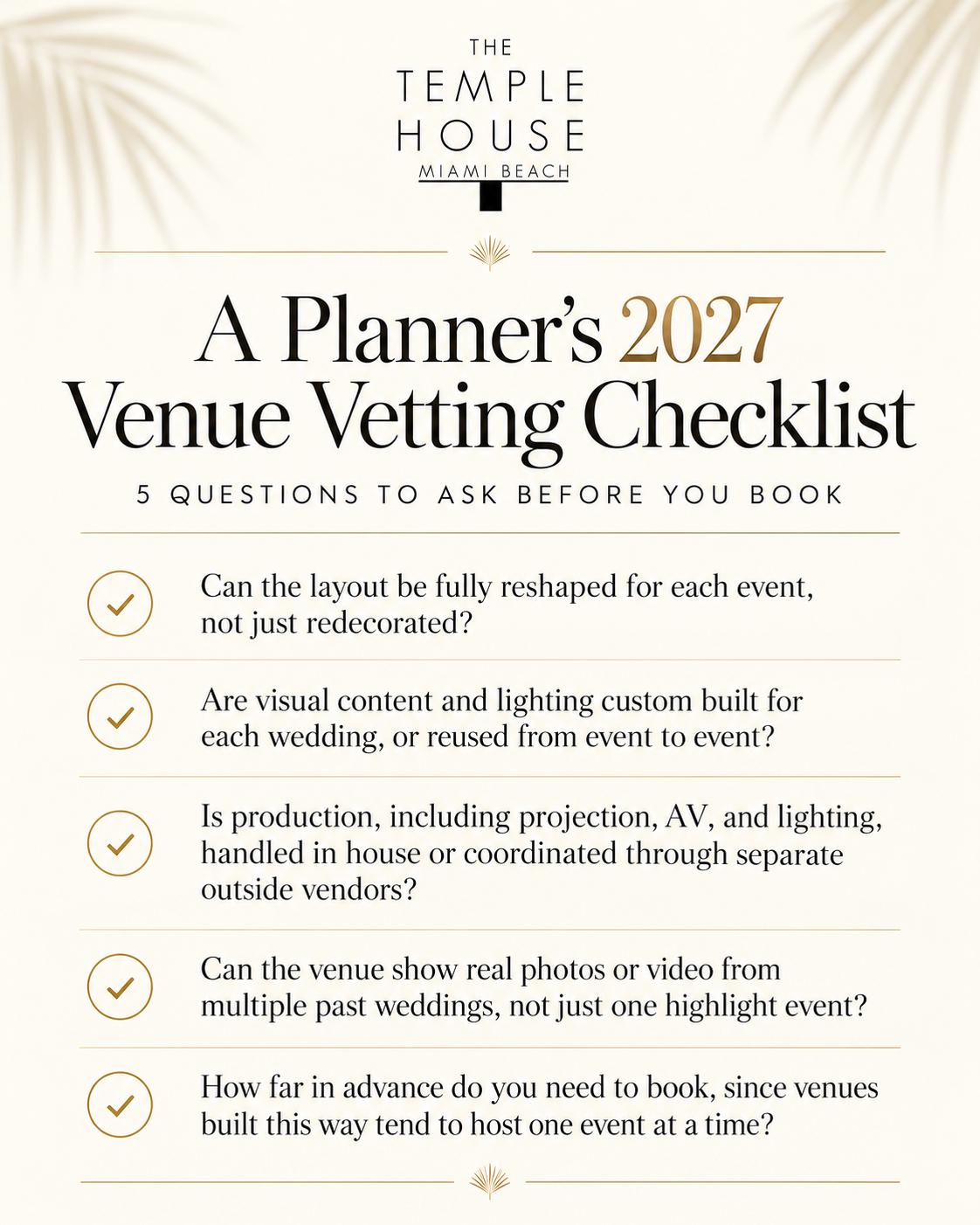
A Planner’s 2027 Vetting Checklist
Pulling the three trends together, here’s what we’d put in front of any venue before adding it to a client proposal for 2027.
Ask whether the layout can be fully reshaped for each event, not just redecorated. Ask whether visual content and lighting are custom built for each wedding or reused from event to event. Ask whether production, including projection, AV, and lighting, is handled in house or coordinated through separate outside vendors. Ask to see real photos or video from multiple past weddings at the same venue, not just the one they lead with. Ask how early you need to book, since venues built this way tend to host one event at a time and fill up faster than traditional ballrooms.
A venue that answers these questions well is one you can confidently build a 2027 proposal around.
Why This Matters More for Planners Than Couples
Couples fall in love with a feeling. Planners have to deliver it, on a timeline, within a budget, with a dozen other vendors depending on the venue doing its part.
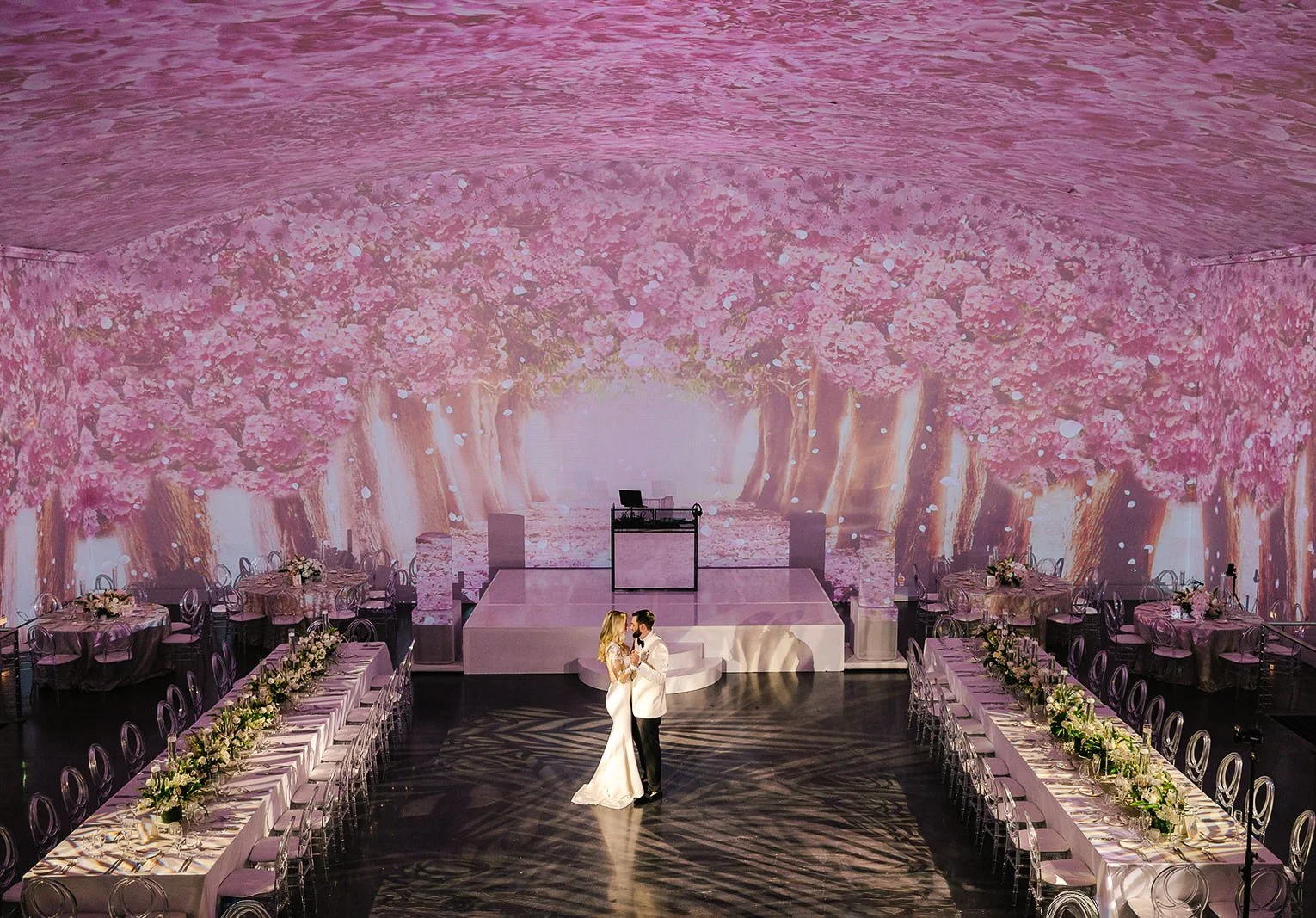
That’s exactly why we built The Temple House the way we did. Every wedding starts from a blank canvas with a permanent 360 degree projection mapping system built into the architecture, run by our own in house team rather than coordinated through separate outside vendors. When a planner brings us a couple’s story, we’re not decorating around it. We’re building the room to tell it.
Ready to Build a 2027 Wedding Around Your Client’s Story?
If you’re putting together proposals for 2027 weddings, we’d love to show you what a true blank canvas venue can actually do. Bring us the story, and we’ll show you what the room can become.
Our venue hosts one event at a time, and dates for 2027 are already moving. Schedule a planner walkthrough and see the space for yourself before you put it in front of a client.
Frequently Asked Questions About 2027 Wedding Trends for Planners
What are the biggest wedding trends planners should expect in 2027?
We expect personalization over extravagance, the venue becoming part of the story instead of a backdrop, and experience over decoration to be the three biggest shifts shaping weddings in 2027.
How can planners tell if a venue is a true blank canvas?
Ask whether the layout and visuals can be completely rebuilt for each event, and ask to see photos or video from several past weddings at the same venue. If every event looks like the same room with different flowers, it isn’t a true blank canvas.
What should planners ask about a venue’s production capabilities?
Ask whether lighting, projection, and AV are built into the venue and run by an in house team, or whether they’re rented and coordinated through outside vendors for each event. That answer affects both cost and reliability on the wedding day.
How far in advance should planners book a custom wedding venue in Miami for 2027?
We’d recommend booking as early as possible, since venues built around full customization and a single event at a time tend to fill their calendars faster than traditional ballrooms.
Why does the venue matter more than decor for a personalized wedding?
Decor can only change the surface of a room. A venue built for transformation can change the entire environment, which is what actually makes a wedding feel personal to the couple instead of just decorated for them.
Want to Learn More About Planning a 2027 Wedding?
What Is a Blank Canvas Wedding Venue
A blank canvas wedding venue has no fixed layout or built in decor, which means it can be rebuilt for every event instead of asking couples to work around a space’s existing look.
What Is 360 Degree Projection Mapping
Projection mapping turns walls, ceilings, and floors into moving visual surfaces, allowing a venue to transform completely between weddings instead of relying on the same look for every event.