Corporate Conferences in Miami Are No Longer Happening in Hotel Ballrooms
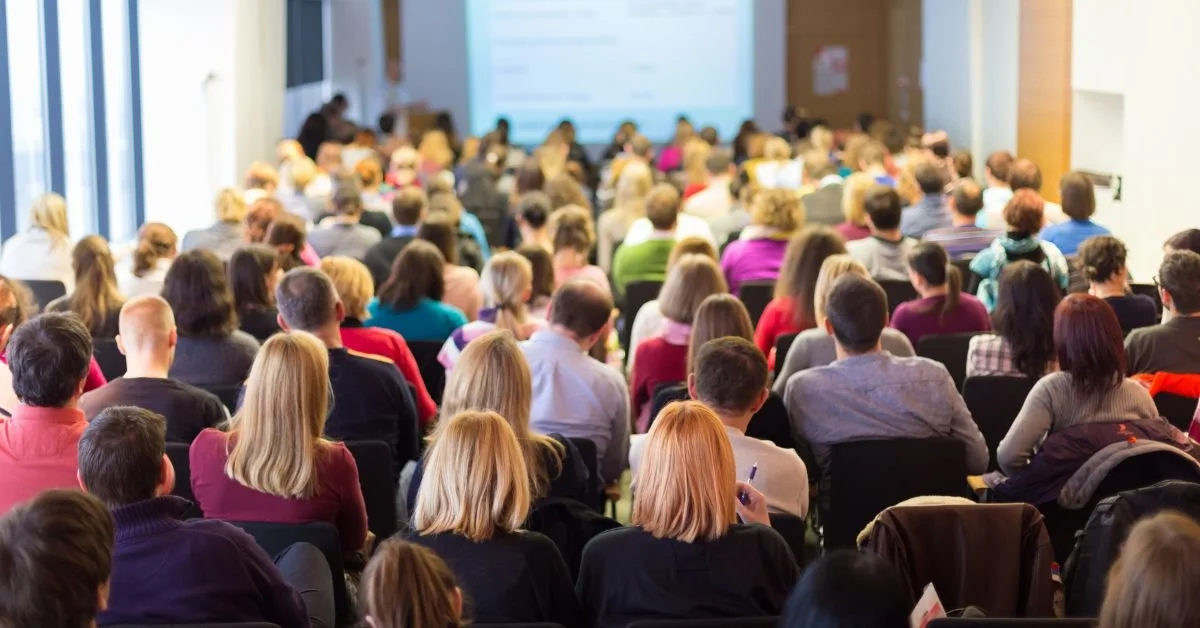
Your executives have sat through hundreds of hotel ballroom conferences. They can feel a forgettable event the moment they walk in. The drop ceiling. The standard podium. The pipe and drape backdrop that looks identical to the last three cities on the tour. They find their seat, they check their phone, and the event has already lost them before the first speaker takes the stage.
The planners who are getting it right in Miami right now are making a different choice. They are choosing environments that do the work before anyone opens their mouth. Spaces where the room itself signals that what is about to happen is worth full attention. We have seen what that decision produces, and there is no comparison.
Here is everything we know about planning a corporate conference or executive summit in Miami that actually delivers.
What We Are Seeing From Planners Right Now
The conversation has shifted. When corporate event planners reach out to us, they are not leading with square footage and AV specs. They are leading with outcomes. What do we want our attendees to feel when they walk in? What do we want them to walk away believing about this company, this leadership team, this vision?
That is a fundamentally different brief than "we need a room for 300 people with a stage and breakout space." And it produces fundamentally different results.
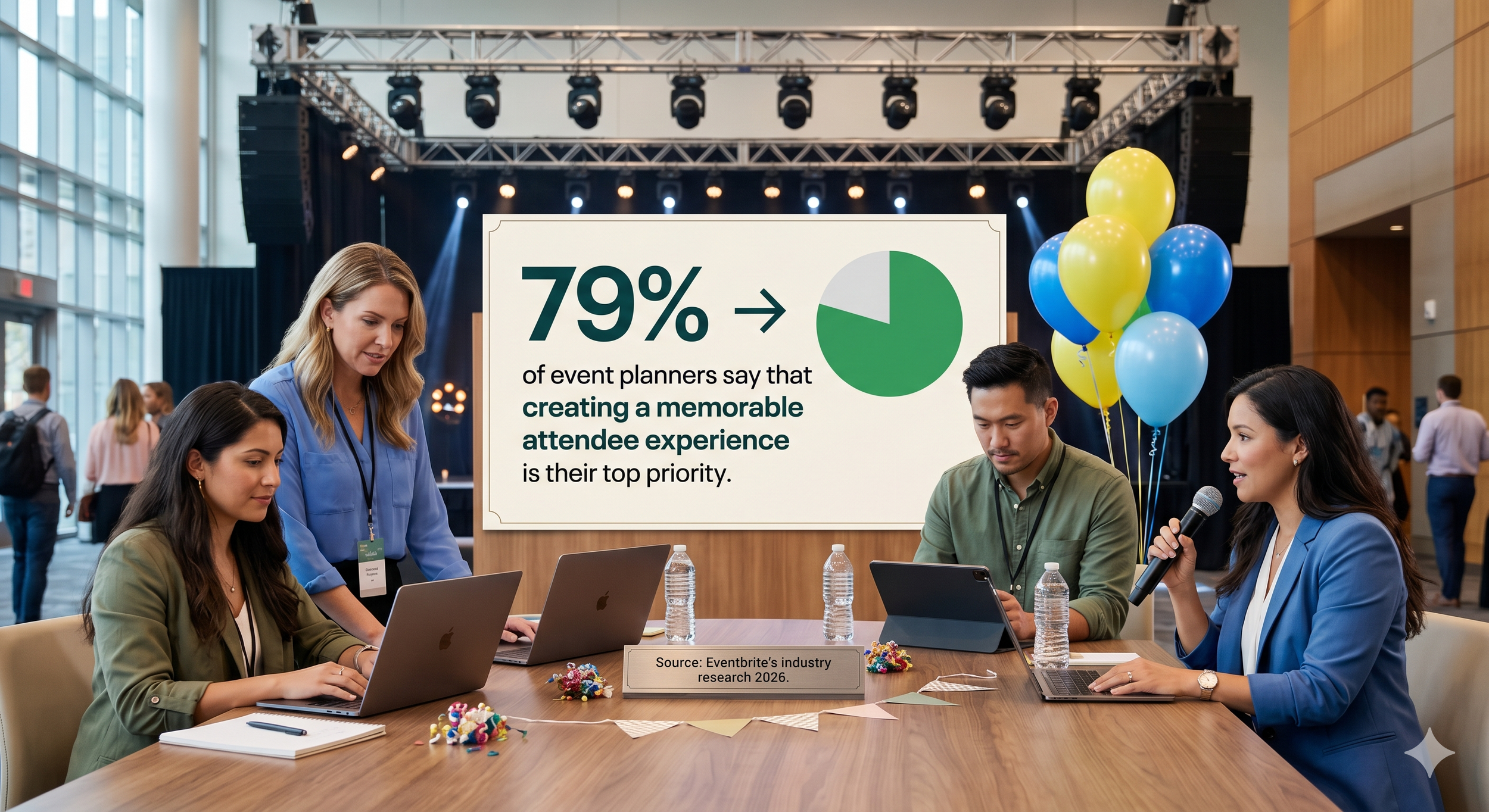
According to Eventbrite's industry research, 79% of event planners say that creating a memorable attendee experience is their top priority, yet the majority of corporate events still default to the same conventional formats. The gap between what planners want to achieve and what standard venues allow them to build is exactly where we operate.
What we provide is a space with no fixed identity. No house look, no default layout, no built-in aesthetic that competes with a brand's vision. A completely blank canvas with the technology to become whatever the event requires. That is rare. In Miami Beach, it is singular.
The 5 Reasons Conventional Venues Underdeliver for High-Stakes Corporate Events
1. The environment contradicts the message. A company bringing its leadership together to talk about bold vision, innovation, and growth is doing it inside a room designed for maximum operational efficiency, not inspiration. The environment and the message are working against each other from the moment attendees arrive.
2. Every event looks like the last one. Hotel ballrooms have a house setup because it works for everyone. Events that work for everyone work exceptionally for no one. The executives in that room have seen this room before. The energy reflects that.
3. Shared property means divided attention. Multiple events running simultaneously in the same building means split staffing, noise bleed, congested parking, and a general energy that makes no single event feel exclusive or considered. For a company investing significantly in bringing its people together, that environment is a tax on the experience.
4. The technology is an afterthought. Standard venue AV is designed for basic presentation needs. Bringing in custom lighting, projection, and production technology into a fixed space is expensive, logistically complicated, and always feels retrofitted. The result is a room that looks like it is trying to be something it is not.
5. There is no wow moment. The best corporate events have at least one moment where the room reacts. Where something unexpected happens, something visually powerful, something that cuts through the professional composure in the room and produces a genuine reaction. Standard venues have no mechanism for that moment. It has to be manufactured from scratch, at cost, every time.
What Aflac Did Differently
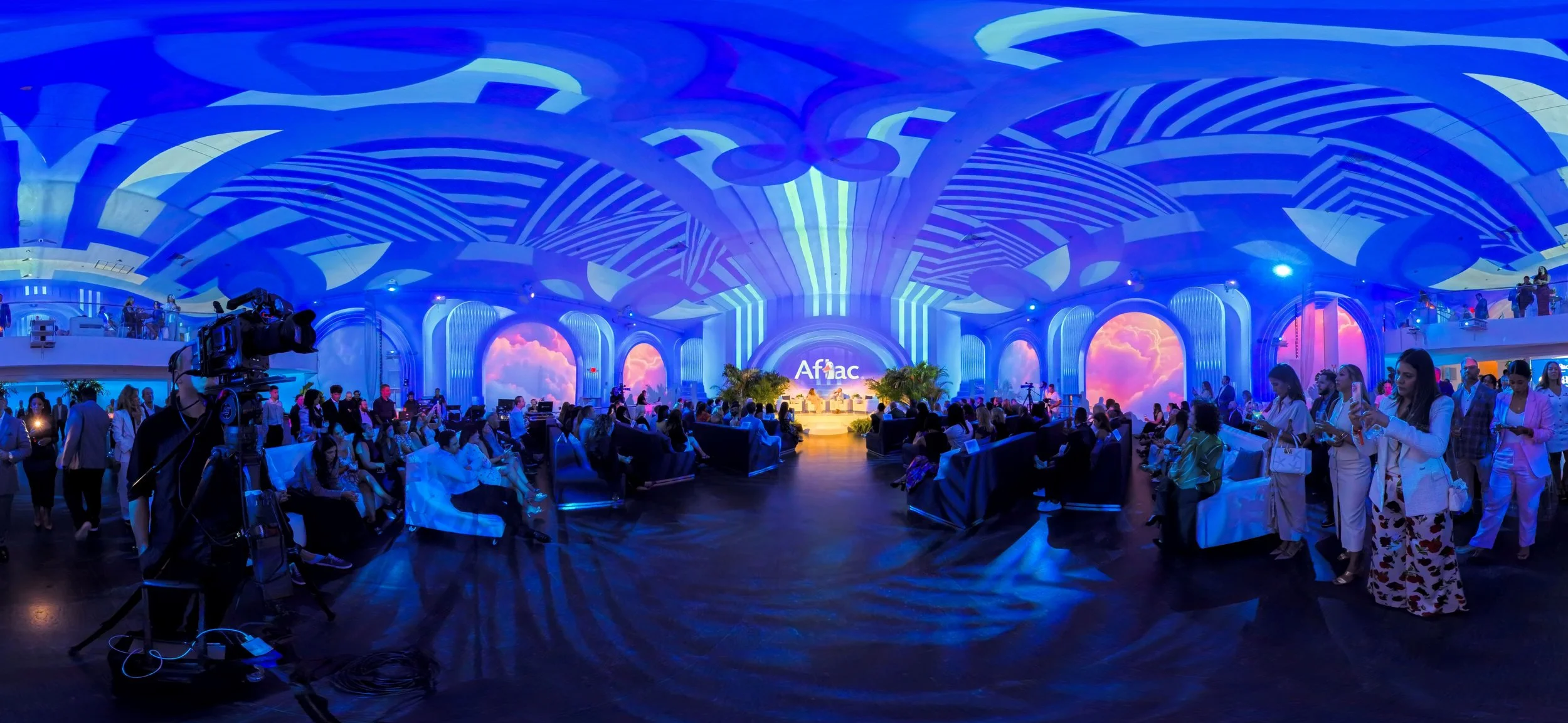
When Aflac brought their Dream Bigger tour to Miami, they needed a venue capable of holding the weight of the message. The tour featured Pitbull in a fireside conversation designed to inspire Aflac's employees, partners, and leaders around a single idea: think beyond what you think is possible.
That message required an environment that embodied it.
They chose The Temple House. Our team transformed the entire space using 360-degree projection mapping, wrapping every wall in custom visuals, motivational phrases, and dynamic animation that shifted and evolved throughout the evening. The room did not just host the conversation. It became part of it.
What Aflac understood, and what the most effective corporate event planners understand, is that the environment is not separate from the message. It is the first expression of it. Before Pitbull said a word, the room had already told every person in it that something different was happening tonight.
The result was a corporate event that attendees described not as a conference but as a cultural moment. That distinction is everything. Read the full event story in our Aflac Dream Bigger blog post.
The Corporate Event Planning Checklist: What the Best Planners Lock In First
The order of decisions matters as much as the decisions themselves. Here is the sequence we recommend to every corporate planner we work with.
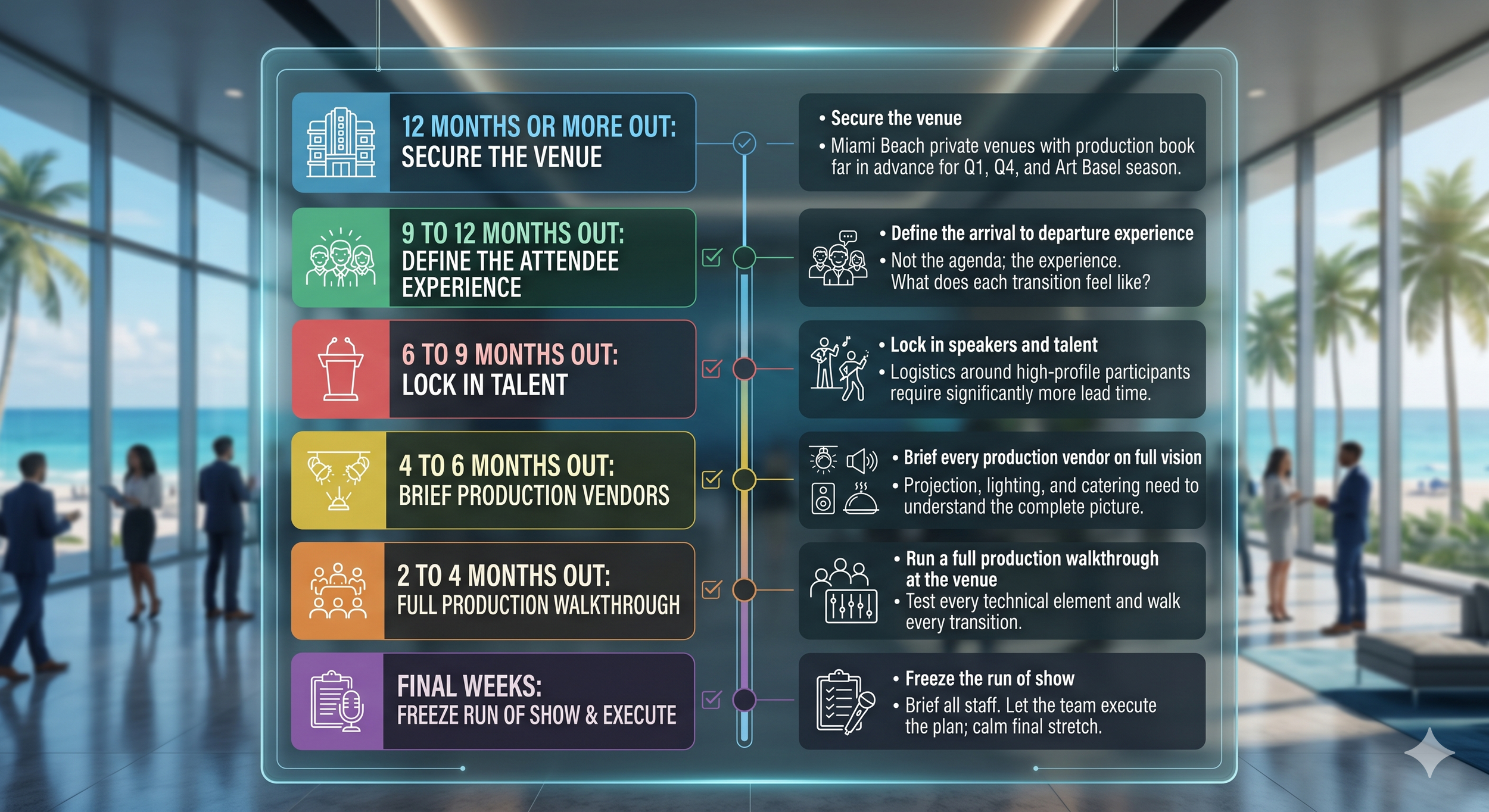
12 months or more out: Secure the venue. In Miami Beach, private venues with full production capability book far in advance for Q1, Q4, and Art Week season. The venue determines everything that follows.
9 to 12 months out: Define the attendee experience from arrival through departure. Not the agenda. The experience. What does each transition feel like? What does the room communicate before the program begins?
6 to 9 months out: Lock in speakers, talent, and any celebrity or executive participants. The logistics around high-profile participants require significantly more lead time than most planners allow.
4 to 6 months out: Brief every production vendor on the full vision, not just their individual scope. Projection, lighting, audio, staging, and catering all need to understand the complete picture to execute their piece of it correctly.
2 to 4 months out: Run a full production walkthrough at the venue. Walk every transition. Test every technical element. Identify anything that needs adjustment before the week of the event.
Final weeks: Freeze the run of show. Brief all staff. Let the team execute the plan. The best events are calm in the final stretch because the work was done before it.
What to Ask Every Corporate Venue You Evaluate
These questions separate the venues that can genuinely serve a high-stakes corporate event from the ones that can accommodate one.
Is this a private, standalone venue or a shared property running multiple events simultaneously?
What production technology is built into the space, and what requires outside rental?
How many corporate events of this scale has this venue produced in the last 12 months?
Who is the dedicated point of contact throughout the planning process, and who is on site managing execution on the day?
What does the room look like completely empty, before any staging or branding is brought in?
Can we speak with a corporate client who has hosted an event here?
What is the load-in window, and how does it account for full production setup?
That last question is one planners often underestimate. A venue that limits setup to a six-hour window forces compromises on production quality. A venue that builds the schedule around the event rather than its own operational convenience produces a different result.
Top 5 Things the Best Corporate Conferences in Miami Have in Common
We have produced corporate events for Fortune 500 companies, global brands, and leadership teams across every industry. The ones that landed, the ones planners told us months later their executives were still talking about, shared these five things.
1. The environment was designed before the agenda was finalized. The room was treated as a communication tool, not a container. What it looked like, felt like, and communicated on arrival was decided with the same intention as the keynote content.
2. There was at least one moment of genuine surprise. Not a gimmick. A moment where something unexpected happened that was so precisely calibrated to the audience that it produced a real reaction. For Aflac, it was walking into a room where every wall was alive with the brand's most ambitious vision of itself. The room earned the conversation before it started.
3. The attendee journey was mapped from the parking lot. The best planners we work with think about the experience before guests enter the building. Valet arrival, the entrance sequence, the first thing attendees see when they walk in. Every moment is considered.
4. The speakers and the environment were in dialogue. The most powerful moments happen when what a speaker says is amplified by what the room is doing around them. Projection, lighting, and sound that respond to the content rather than running on a preset loop.
5. The event had a clear emotional arc. It built toward something. Attendees arrived at one energy level and left at another. That arc was designed, not accidental.
Why Miami Beach Is the Right City for This
Miami is one of the most commercially active cities in the United States for corporate events. The city draws global brands, international leadership teams, and the kind of executive talent that responds to an environment worthy of their attention.
What Miami Beach specifically offers that no other market matches is the intersection of world-class culture, climate, and infrastructure. Companies that bring their teams here are already signaling that this event matters. The venue needs to confirm that signal the moment guests arrive.
The Art Deco Historic District, where we are located, adds a layer of architectural distinction that no constructed conference facility can replicate. The bones of this building, and what we build inside it, produce an experience that feels unlike anything available in a conventional event market.
We have helped corporate clients from across the country and internationally choose Miami Beach as their destination event city specifically because of what is possible here that is not possible anywhere else. Our corporate events page and experiential events page show the range of what we have built.
What We Provide
The Temple House is a private, standalone event venue in Miami Beach accommodating up to 500 guests. One event at a time. No shared property. No competing events in the building. Full 360-degree projection mapping built into the architecture. Complete production capability including lighting design, audio, and staging. A dedicated team from the first planning conversation through the final moment of the event.
For corporate conferences and executive summits specifically, we provide the kind of environment that makes a leadership team's message land the way it deserves to. The room does work that a standard venue simply cannot do.
Explore more on our corporate events page and our projection mapping capabilities.
Your Next Step
If you are planning a corporate conference, executive summit, or leadership event in Miami and you want to talk about what the experience could look like, we want to hear from you. Tell us the outcome you are trying to produce. The audience. The message. What you want people to feel when they leave.
That is the conversation we are built for. Start it here.
The Temple House 1415 Euclid Avenue, Miami Beach, FL 33139 (305) 673-2526
Frequently Asked Questions About Corporate Events in Miami
What makes The Temple House different from hotel conference venues in Miami? We are a fully private, standalone venue hosting one event at a time. Our 360-degree projection mapping technology is built into the architecture, which means the entire room transforms for each event. No shared ballrooms, no competing events on the same property, no fixed house look that competes with a brand's identity.
What types of corporate events does The Temple House specialize in? We produce corporate conferences, executive summits, leadership events, product launches, brand activations, award galas, fireside chats, and high-production corporate experiences. We have hosted Fortune 500 companies, global brands, and celebrity-featured corporate events including Aflac's Dream Bigger tour featuring Pitbull.
How far in advance should we book a corporate venue in Miami Beach? We recommend beginning the conversation 9 to 12 months in advance for large corporate events. Q4 and Art Basel season dates fill earliest. Once a date is confirmed, the planning process begins immediately.
Does The Temple House have in-house production capability? Yes. Our 360-degree projection mapping system is built into the venue and operated by our production team. We work with trusted production partners for lighting design, audio, staging, and custom content creation.
What is the capacity for a corporate event at The Temple House? We accommodate up to 500 guests in a fully flexible layout that supports theater-style conferences, gala rounds, cocktail receptions, fireside formats, and hybrid configurations.
What is the starting investment for a corporate event at The Temple House? Events start at $50,000. This reflects a fully private, fully produced experience with integrated immersive technology, dedicated team support, and exclusive use of the entire venue for your event.
Can The Temple House accommodate celebrity speakers or high-profile executive talent? Yes. We have produced events featuring global performers, Fortune 500 executives, and celebrity talent. The venue includes a VIP lounge, green room, and all supporting infrastructure for high-profile participants.